
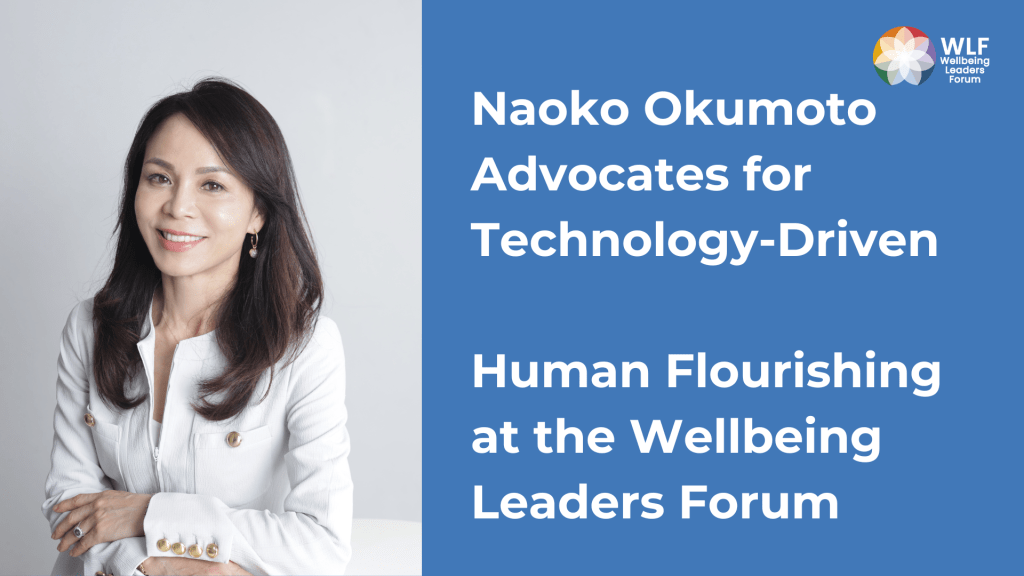
At the Wellbeing Leaders Forum, Naoko Okumoto, the Founder and Managing Partner of NIREMIA Collective, delivered a deeply personal and forward-thinking presentation on the urgent need for innovation in mental, emotional, and social health. Based in Silicon Valley, NIREMIA Collective is a wellbeing tech fund that invests in early-stage startups aiming to change society through technology, with a focus on human flourishing and democratizing access to solutions that enhance health, happiness, and personal growth.
Ms. Okumoto opened her session by sharing the deeply personal story that led her to establish the fund in 2021. Her younger brother, 22 years her junior, passed away after a long battle with depression. After succeeding their family business, he struggled to find purpose, and as his health declined, he ultimately lost his will to live. Describing him as her “closest soul” and “best friend,” Ms. Okumoto explained that his passing became the catalyst for her commitment to ensuring that everyone has the opportunity to live an authentic life — not by comparing themselves to others, but by being the best version of themselves.
She emphasized that if technology can reach even one person who is suffering and give them a moment to breathe easier, then investing in such innovation is not only worthwhile but vital.
Ms. Okumoto states that NIREMIA Collective is committed to unlocking human potential through technology. The fund invests in startups working across a spectrum of wellbeing domains, including preventive health, longevity, emotional and mental health, the future of work, collective intelligence, and personalized growth — a concept she aligns with the Japanese word ikigai, or “purpose of life.”
Addressing the current state of the mental health sector, Ms. Okumoto highlighted the paradoxical language of venture capital: although the “growth” of the mental health market may appear positive in financial terms, its expansion reflects a deepening crisis. In 2022, the global mental health market was valued at approximately $400 billion USD and is projected to grow to $560 billion by 2030 (ResearchAndMarkets.com, 2023). She identifies key drivers of this growth, such as increased awareness and education that help reduce stigma — particularly among younger generations who speak more openly about mental health.
She links this cultural shift to broader trends, including the global rise in demand for mental health services, especially in the aftermath of COVID-19. The phenomenon of the “great resignation” saw employees leaving companies that failed to address their mental and emotional needs. In response, major tech companies in Silicon Valley — including Google, Facebook, and Amazon — began offering wellbeing solutions to employees, creating significant B2B opportunities for mental health service providers.
Ms. Okumoto draws attention to the prevalence of mental health challenges globally, noting that “one in five adults experience a mental illness, and one in 20 experience serious mental illness,” mirroring data from both Australia and the U.S. She shares her initial hesitation to talk about her brother’s experience, but after confiding in friends, she found many had their own stories — whether it was long-term antidepressant use, bipolar disorder in a family member, or siblings unable to leave their rooms.
She underscores that mental health struggles are not always clinical; they can manifest as chronic insomnia, morning fatigue, or various dependencies — on medication, alcohol, shopping, video games, or even chocolate, she adds. As a mother of a teenage son, she expresses concern about the pressure cooker environment teens face: trying to look good on social media while lacking meaningful personal connections. As a result, 17% of youth aged 16–17 experience some form of mental health disorder, even in affluent communities like Palo Alto, the heart of Silicon Valley (Centers for Disease Control and Prevention, 2024).
Ms. Okumoto’s presentation concluded with a clear message: addressing mental, emotional, and social health is not just a moral imperative, but a societal one. Technology, when purposefully deployed, can offer not just convenience or efficiency, but hope, connection, and healing.
Bibliography
- Centers for Disease Control and Prevention. (2024, August 20). Data and statistics on children’s Mental Health. Centers for Disease Control and Prevention. https://www.cdc.gov/children-mental-health/data-research/index.html?utm_source=chatgpt.com
- ResearchAndMarkets.com. (2023, September 5). Global Mental Health Market to reach $560.33 billion by 2030, driven by increasing awareness and aging population – researchandmarkets.com. Global Press Release & Newswire Distribution Services. https://www.businesswire.com/news/home/20230905027096/en/Global-Mental-Health-Market-to-Reach-%24560.33-Billion-by-2030-Driven-by-Increasing-Awareness-and-Aging-Population—ResearchAndMarkets.com
Editor – Miki Yamaoka

Having moved between New Zealand and several other regions since childhood, Miki grew up in an environment where diversity was the norm. She graduated from medical school in Hungary and is passionate about contributing to wellbeing beyond the walls of hospitals as a clinician.
 Wellbeing Leaders Forum
Leave a comment